
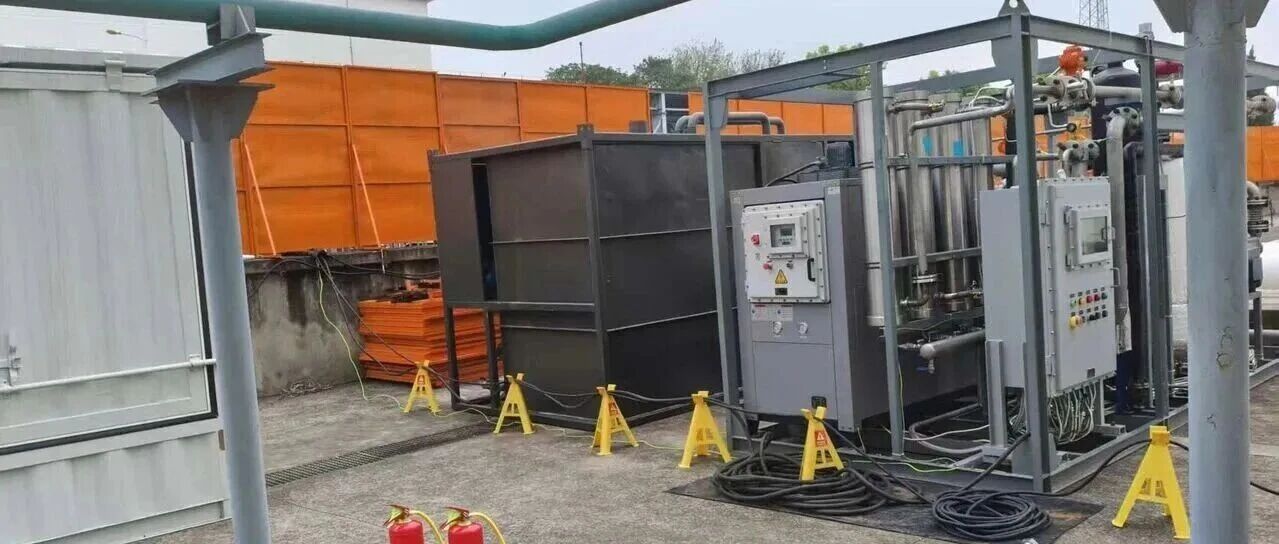
Compared with large crude oil storage tanks, tanks with capacities below 10,000 m³ are smaller, and many people may instinctively assume that a smaller tank must naturally be easier to clean.
On actual project sites, however, the situation is often not so straightforward.
Refined product tanks, chemical storage tanks and small crude oil tanks in oilfields may have similar capacities, yet differ considerably in their stored media, internal structures, tank-bottom deposits and on-site operating conditions.
For tanks below 10,000 m³, the real challenge in mechanized cleaning is not simply whether they can be cleaned, but how to make the equipment genuinely suited to the tank and the site.
01 Smaller Tanks Do Not Mean Uniform Operating Conditions
Tanks below 10,000 m³ actually cover a very broad range of applications.
They include refined product storage tanks for gasoline, diesel and aviation kerosene, as well as chemical storage tanks and small crude oil storage tanks in oilfields.
The residual oil, sludge and deposits formed during long-term storage of different media are not all the same, and the corresponding cleaning requirements also vary.
The first issue to address in mechanized cleaning of small tanks is therefore not simply selecting equipment by capacity, but assessing the specific operating conditions in light of the stored medium, deposits and project objectives.
02 Internal Structure Deserves More Attention Than Capacity
In addition to capacity, a tank's internal structure is another important factor affecting equipment application.
In internal floating roof tanks in particular, the floating deck, support columns and other internal components all affect equipment placement and cleaning coverage.
Where will the equipment enter?
How will it be positioned once inside?
How can it cover as much of the area requiring treatment as possible?
When working around internal components, how can additional dismantling and reassembly of the existing structure be minimized?
None of these questions can be answered on the basis of “tank capacity” alone.
For tanks below 10,000 m³, the equipment's flexibility and adaptability are therefore often more important than simply pursuing greater processing capacity.
03 Limited Site Space Also Affects How Equipment Is Used
Tank cleaning does not take place solely inside the tank; it is also an on-site engineering operation.
Bringing equipment onto the site, connecting piping, arranging power supplies, establishing operating areas and organizing personnel all require a certain amount of space.
At some oil depots, refineries and chemical facilities, the layout of equipment, piping and roads around small and medium-sized tanks may already be relatively compact.
In such cases, a mechanized cleaning system involving numerous pieces of equipment and a complex layout will make site coordination more difficult.
Beyond being able to complete the cleaning, mechanized solutions for small and medium-sized tanks should therefore give as much consideration as possible to the following:
Whether equipment can be brought onto the site easily, whether the system is easy to set up, and whether work can be organized flexibly enough.
This is also why tanks of different sizes are not necessarily suited to exactly the same equipment configuration.
04 Mechanization Does Not Simply Mean Downsizing Equipment
Developing mechanized cleaning equipment for small and medium-sized tanks is not simply a matter of making a large system smaller.
The issues that actually need to be addressed are:
- How to accommodate different tank types;
- How to reduce the operational burden created by complex equipment layouts;
- How to adjust cleaning positions and working methods to actual site conditions;
- And how to make the fullest possible use of mechanized equipment within limited spaces and complex internal structures.
The essentials of mechanized cleaning for small and medium-sized tanks can therefore be summarized in three key terms:
Compact design, flexibility and application-specific adaptability.
Only when the equipment genuinely matches the project conditions can the advantages of mechanized cleaning be realized in actual operations.
05 Assess the Tank First, Then Discuss the Equipment
There is no single, completely fixed cleaning configuration for tanks below 10,000 m³.
Differences in tank type, stored medium, internal structure and tank-bottom deposits should lead to corresponding differences in the final equipment configuration and work plan.
Before starting a mechanized cleaning project, the more sensible sequence is therefore:
Assess the tank first, then discuss the equipment.
In subsequent articles, we will take a closer look at the equipment itself and introduce several issues worth considering in mechanized cleaning of tanks below 10,000 m³: how equipment enters through a manhole, how the cleaning process can be visually monitored, how cleaning guns can improve operational flexibility, and what practical issues equipment design must address when working with internal floating roof tanks.
Mechanized Tank Cleaning Equipment Rental and Cleaning Services
Tecway Industrial provides two types of business offering to meet mechanized tank cleaning needs: equipment rental and cleaning services.
Equipment Rental
For tank cleaning companies and engineering service providers, suitable equipment can be configured according to tank type, project conditions and actual cleaning requirements.
Companies whose project volumes fluctuate or whose equipment use is intermittent can flexibly configure equipment for individual projects, reducing upfront equipment investment and the burden of prolonged equipment idleness.
Cleaning Services
For tank farm owners and operators such as oil depots, refineries, chemical companies and oilfields, we provide mechanized tank cleaning project services tailored to tank type, stored medium, site conditions and project requirements, developing corresponding work and cleaning plans based on actual operating conditions.
About Tecway Industrial
Tecway Industrial System Limited, formerly Tecway International (Petrochemical) Limited, was established in Hong Kong in 1995; Beijing Tecway Xuyang Industrial Equipment Co., Ltd. is its subsidiary registered in Beijing.
Tecway Industrial System Limited and Beijing Tecway Xuyang Industrial Equipment Co., Ltd. primarily provide services related to equipment imports for industries including oil and gas storage and transportation and petrochemicals. As consultants and distributors, we carefully select viable, high-quality and cost-effective solutions for our customers, sourcing products from reputable suppliers around the world.
Website: tecwayintl.com
Email: jacky.xiong@tecwayintl.com